
Une procédure clinique agrandie

  • Par
  • Publié le . Paru dans Biomatériaux Cliniques n°1 - 31 mars 2016 (page 72-73)
Information dentaire
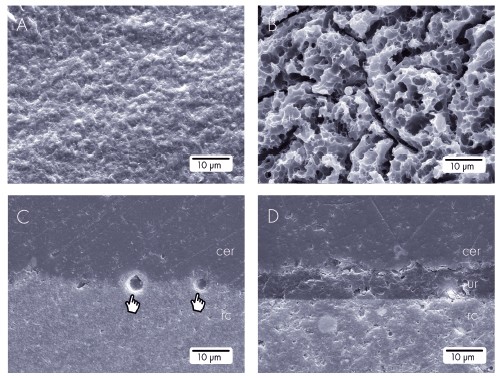
Dans cette rubrique, l’auteur explique pourquoi il pense qu’il faudrait peut-être appliquer une résine hydrophobe non chargée dans l’intrados de la céramique (sans la photopolymériser) après mordançage et application du silane, ce qui n’est pas la procédure habituelle. Cela donne l’occasion de visualiser de magnifiques vues en Microscopie Electronique à Balayage (MEB).

Nano Spaces, Micro Structures, Macro Lessons

An invitation to look at everyday dentistry from a new perspective. From macro to micro to nano approach calls for a theory of multi-level models, where it is possible to defragment daily dentistry procedures from a microscopic perspective. Be able to see and to understand what happens in reduced scales, enlarge horizons on our daily practice.

Do you use adhesive at the inner surface1 of ceramic restorations ? Does it make any difference on bond strength2  ? On durability and reliability of ceramic-resin interfaces ?
These are a very frequent question the clinician faces when dealing with adhesive bonding of ceramic restorations. Well, let us take a step back and try to understand the whole scenario of etching3 and bonding procedures.
The surface modification of glass ceramics4 by etching results in increased contact surface area, improving the interaction between the ceramic and the bonding agent. To take full advantage of the increased energy on etched surfaces, the cement needs sufficient wettability5 to completely infiltrate the irregularities. Most manufacturers recommend the use of resin cements directly on the internal silanated ceramic surface. It remains questionable, however, if bonding resin only is efficient in properly wetting the surface and filling up all irregularities created by the etching process. This is especially of concern considering that the internal surfaces of indirect restorations are commonly irregular, macroscopically and microscopically. The use of a thin layer of unfilled resin (adhesive)6 after the silane has been advocated7 recently, and being able to see the consequences of this additional clinical step from a microscopic perspective could reinforce its importance. The use of this low-viscosity material (prior bonding cement material) improve adaptation of substrates along the ceramic-polymer interface, as well as the bonding strengths [1, 2].
On the SEM8 micrographs (D) is possible to see that the application of a hydrophobic low-viscosity…


Cet article est réservé aux abonnés.
Pour lire la suite :

Vous êtes abonné.e ? Connectez-vous
Mot de passe
oublié ?

Vous pouvez également :

Acheter l'article En version numérique
Acheter le numéro À l'unité

Thèmes abordés

Sur le même sujet

Biomatériaux

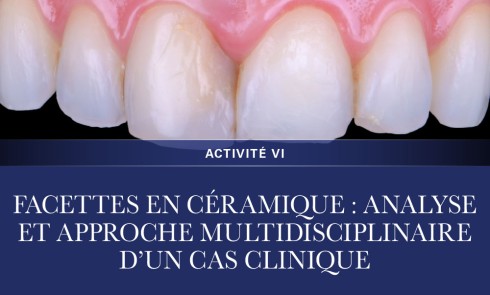
Article réservé à nos abonnés Facettes en céramique : Analyse et Approche Multidisciplinaire d’un cas clinique

1/ Il faudrait donner de la dominance aux incisives centrales de cette patiente en rallongeant leur bord incisif. Les conditions...
Biomatériaux

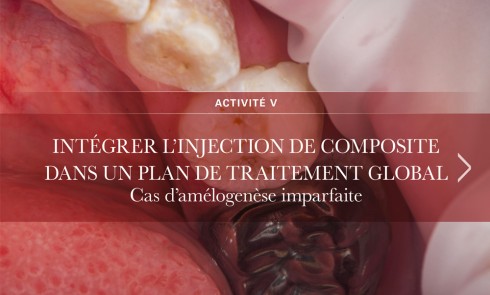
Article réservé à nos abonnés Intégrer l’injection de composite dans un plan de traitement Global. Cas d’amélogenèse imparfaite

1. Par où commence-t-on pour planifier un tel plan de traitement ? La planification d’un traitement global de réhabilitation esthétique et...
Biomatériaux

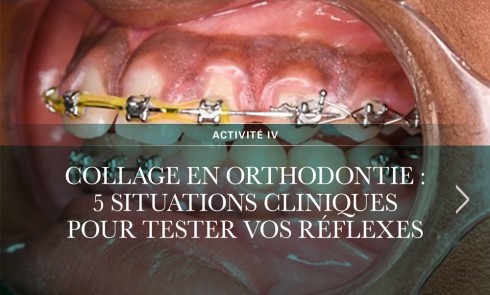
Article réservé à nos abonnés Collage en orthodontie : 5 situations cliniques pour tester vos réflexes

Cette activité propose cinq situations cliniques illustrant des problématiques courantes rencontrées lors du collage orthodontique et du suivi des traitements...
Biomatériaux

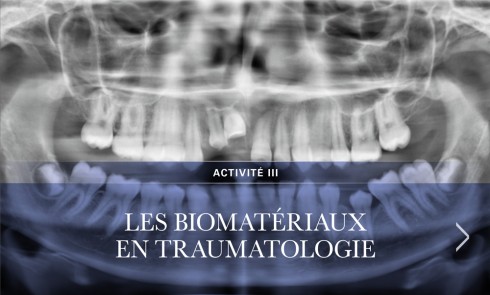
Article réservé à nos abonnés Les biomatériaux en traumatologie

Les usages et donc les connaissances en biomatériaux sous-tendent la plupart de nos actes en omnipratique, comme en odontologie pédiatrique....
Biomatériaux

Article réservé à nos abonnés MIH sévère et érosion-infiltration en denture mixte

Situation clinique initiale Une enfant de 11 ans consulte accompagnée de ses parents pour un motif esthétique : elle exprime une...
Biomatériaux

Article réservé à nos abonnés Traitement d’une dyschromie unitaire chez un patient mineur

Cas clinique Patient de 15 ans qui se présente au cabinet car il est gêné par la couleur de son...